New: updated for the 2026 Digital Omnibus

Avoiding Checkmate

Become a Grandmaster of the EU AI Act

Chess: The AI Act Framework

The plain-English guide for business leaders. The EU AI Act is a rulebook; chess is a game with a rulebook you already half know. This book uses one to explain the other, one AI system at a time, with a cast of seven, seventy-five quiz questions and a certificate at the back.

The bans, the transparency duties and the model rules apply now. The fines started in August 2026. The high-risk rules land in December 2027.

Paperback in colour and Kindle. By Matthew Blakemore, contributor to the EU AI Office's General-Purpose AI Code of Practice.

Matthew Blakemore, at a chessboard, holding his book Avoiding Checkmate: Become a Grandmaster of the EU AI Act
0 chapters in 4 parts A cast of 0 organisations 0 figures and 17 cartoons 0 quiz questions, answered Every date on the clock A certificate to frame
The method behind the book, the game and the training

Chess: The AI Act Framework

The EU AI Act on one board. Every piece is a part of the law, every special move is a rule, the clock is the dates and the arbiter is the regulator. Learn six pieces and you can place any AI system your business owns.

The kingYour business
The queenGeneral-purpose models
The bishopsTwo routes into high risk
The knightsTransparency duties
The rooksThe seven requirements
The pawnsMinimal-risk AI
The book

The plain-English guide to the EU AI Act for business leaders

No law degree required. Five questions decide every case, a cast of seven plays them through, and the Article references sit in a corner for your lawyer.

No law degree required

No Article numbers in the text. Every chapter says the rule simply, shows what it means for a business, and puts the references in a corner for your lawyer.

One system at a time

Is it an AI system, is it on the board, which hat do you wear, which tier, which date. Learn the five, then watch the cast play them.

Built on a framework

Chess: The AI Act Framework

It maps the Act onto the pieces you already know, so the whole law fits on one board, and one page.

Avoiding Checkmate
Pre-order

Paperback in colour, and Kindle

About 190 pages, printed in colour, or the Kindle edition with every figure. Both updated for the 2026 Digital Omnibus.

  • Fifteen chapters, each built the same way, so you always know where you are
  • A cast of seven organisations making the moves your business will make
  • Forty-four figures and seventeen cartoons, drawn for people who run businesses
  • Seventy-five quiz questions and fifteen puzzles, answered with the Article
  • The Decoder, every date on the clock, and the sources for your lawyer
  • The code that unlocks the moves in the game
  • A certificate at the back, to frame and put on your desk at work

Who it is for

Chief executives, finance directors, heads of product, HR and operations, founders, in-house counsel who need a plain-English brief for the board, and anyone who has been told "the AI Act is delayed" and suspects that is not the whole story.

Bulk copies for your board or your clients, and orders by ISBN through your bookshop.

What is inside

Every chapter, the same shape

Fifteen chapters, and each one built from the same ten parts, in the same order, so you always know where you are.

Say it simply

The chapter in one sentence, before anything else.

The rule, in plain English

No Article numbers. What the law says and what it means for a business.

Casebook

Seven fictional organisations make the moves, and the mistakes.

Rule update 2026

What the Digital Omnibus changed here, struck through and ticked.

Blunder to avoid

The mistake real businesses make with this part of the Act.

Your move

Three to five things you can do this month, with an owner line.

Mate in one

A puzzle. One system, one question, the answer at the back.

Chapter quiz

Five questions, four options, answered with the Article.

Consult the arbiter

When this is a lawyer's question, and what to bring them.

Lawyer's corner

The Articles, recitals and Annexes behind the chapter, for your lawyer.

Dramatis personae

Seven organisations, none of them real

They make the moves your business will make, and the mistakes it can avoid, one chapter at a time. Everything that happens to them is the law.

HRMid-sized firm

Hallam & Rook

Nineteen AI systems, one brochure that promised too much, and a managing director who asks the awkward question first.

PBSRegional lender

Pemberton Building Society

Forty systems, a head of risk who assumes every one of them is sensitive, and a budget that turns out to be wrong in the right direction.

MLLift manufacturer

Marchbank Lifts

Twenty years of certified lifts, and door software that has quietly started making decisions its makers never described.

TAGRegional newspaper

The Arden Gazette

An AI drafting desk, a synthetic voice reading the headlines, generated pictures, and an editor with a nagging feeling about labels.

LLAI start-up

Larkspur Labs

A model that has read a very great deal, a founder who would rather nobody saw the list, and a whiteboard with a number on it.

FDCLocal authority

Fellbrook District Council

A police proposal for cameras in the market square, a benefits tool nobody read the manual for, and a resident who writes in.

TTRThree cafes

Tilly's Tea Rooms

A booking bot, a spam filter, an operations manager with a free tool he found, and forty job applications read on the train.

The game

See where your AI systems stand, free

Chess: The AI Act Framework

Describe one AI system, answer a few plain-English questions, and watch a piece appear on the board: what it is, which hat you wear for it, whether it is in check, and when the flag falls. The moves that get it to safety, the board pack for your next board meeting and Grandmaster mode unlock with the code printed in the book. Your board saves in your browser and nowhere else.

A guide, not legal advice. Every question in the game is a chapter in the book.

How it plays: a system arrives, the board says what it is, a red ray means a duty is outstanding, and the piece moves to safety when the duty is met. Hover to pause.

At the back

Frame it. Put it on your desk. Wait for someone to ask.

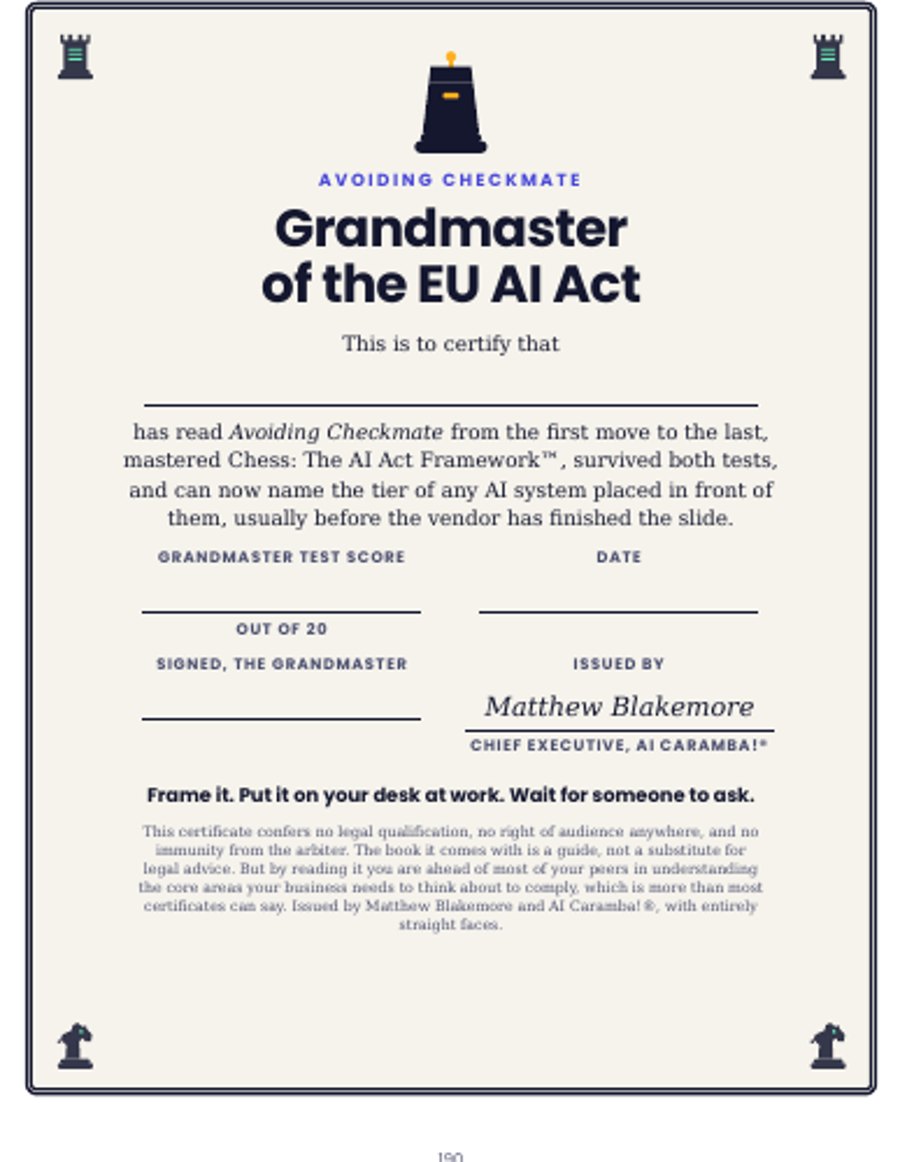
The last page of the book is a certificate: Grandmaster of the EU AI Act, issued by Matthew Blakemore and AI Caramba!, with entirely straight faces. Fill in your name and your score on the Grandmaster test, sign it, and hang it where the vendors can see it.

The Grandmaster of the EU AI Act certificate from the back of the book
“The Act rewards boring competence. This is unusual for a regulation and worth savouring.”From Chapter 1, Why chess
The clock

The dates that matter

The Act applies in stages, and the 2026 rule update moved some of the dates. The four most businesses need to diarise; the complete clock is in the book.

2 December 2026Two further prohibitions apply
2 August 2027Legacy general-purpose models comply
2 December 2027The high-risk rules apply to listed uses
2 August 2028The high-risk rules apply to AI in regulated products
Matthew Blakemore speaking on stage
The author

Matthew Blakemore

Chief executive of AI Caramba!, a contributor to the EU AI Office's General-Purpose AI Code of Practice, one of four global sub-editors who co-authored and co-edited ISO/IEC 8183, and a member of the Innovate UK BridgeAI Advisory Committee. His work over more than a decade spans AI strategy, product development, governance and standards.

FAQ

Questions people ask

What is the EU AI Act?

Regulation (EU) 2024/1689, the European Union's rulebook for artificial intelligence, amended in July 2026 by the Digital Omnibus on AI. It sorts AI by what it is used for, with a handful of banned uses, a high-risk tier, transparency duties, and nothing new for most systems. Chapters 1 to 4 of the book set out the whole board.

When does the EU AI Act apply?

In stages between February 2025 and August 2030; the high-risk rules for listed uses apply from 2 December 2027 and for AI in regulated products from 2 August 2028. Every date is on our clock page; Chapter 13 explains which ones are yours.

Was the EU AI Act delayed by the Digital Omnibus?

The high-risk dates moved; nothing already in force paused, and the requirements did not change. Chapter 13 sets out, in two columns, exactly what the 2026 update changed and what it did not.

Does the EU AI Act apply to UK or US companies?

Yes, where an AI system is placed on the EU market, used in the EU, or its output is used in the EU. Chapter 2 walks through the five ways onto the board.